Overdue Company Accounts and Late Filing
If your company accounts are overdue at Companies House, the most important thing is not to ignore the problem.
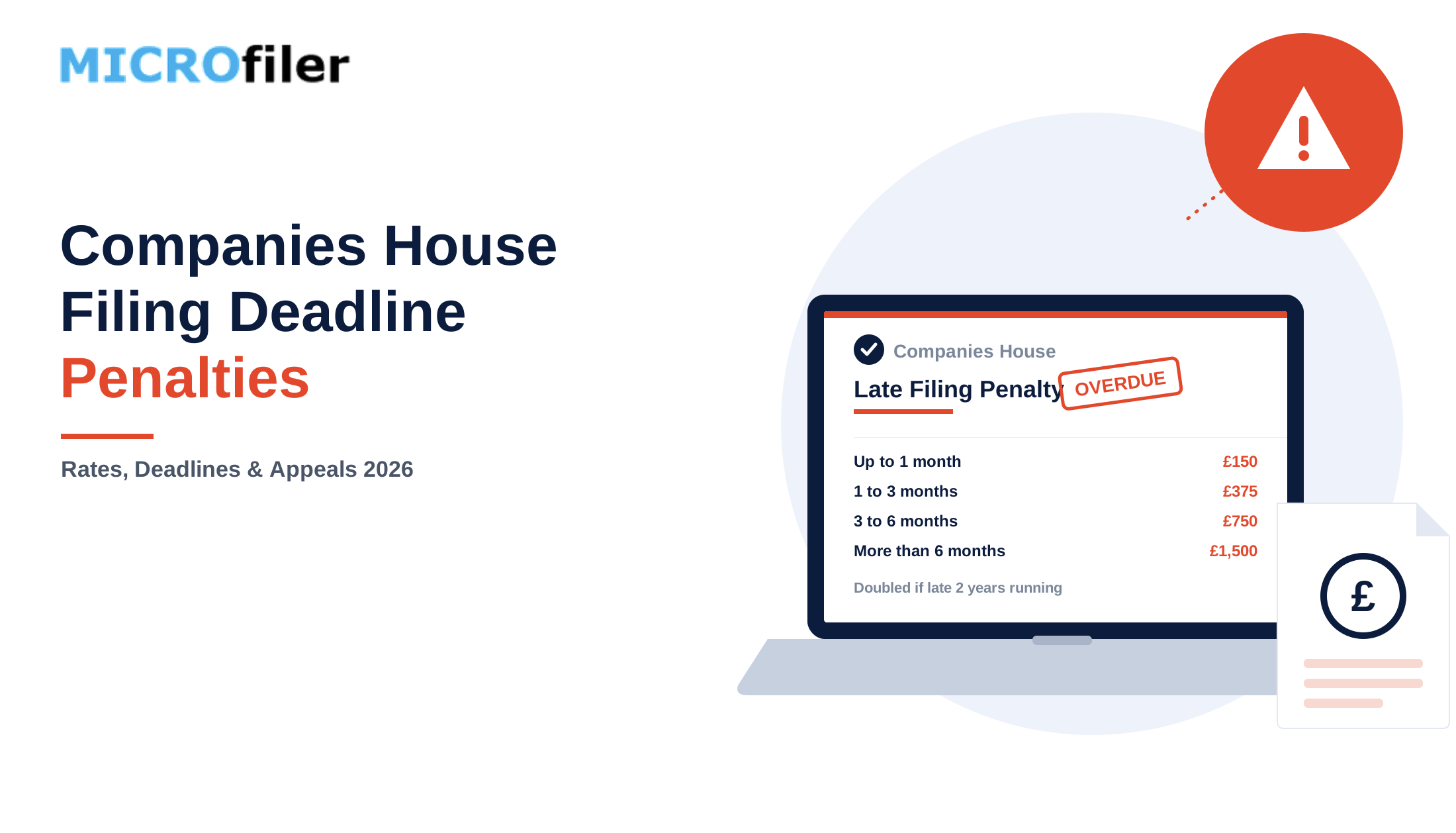
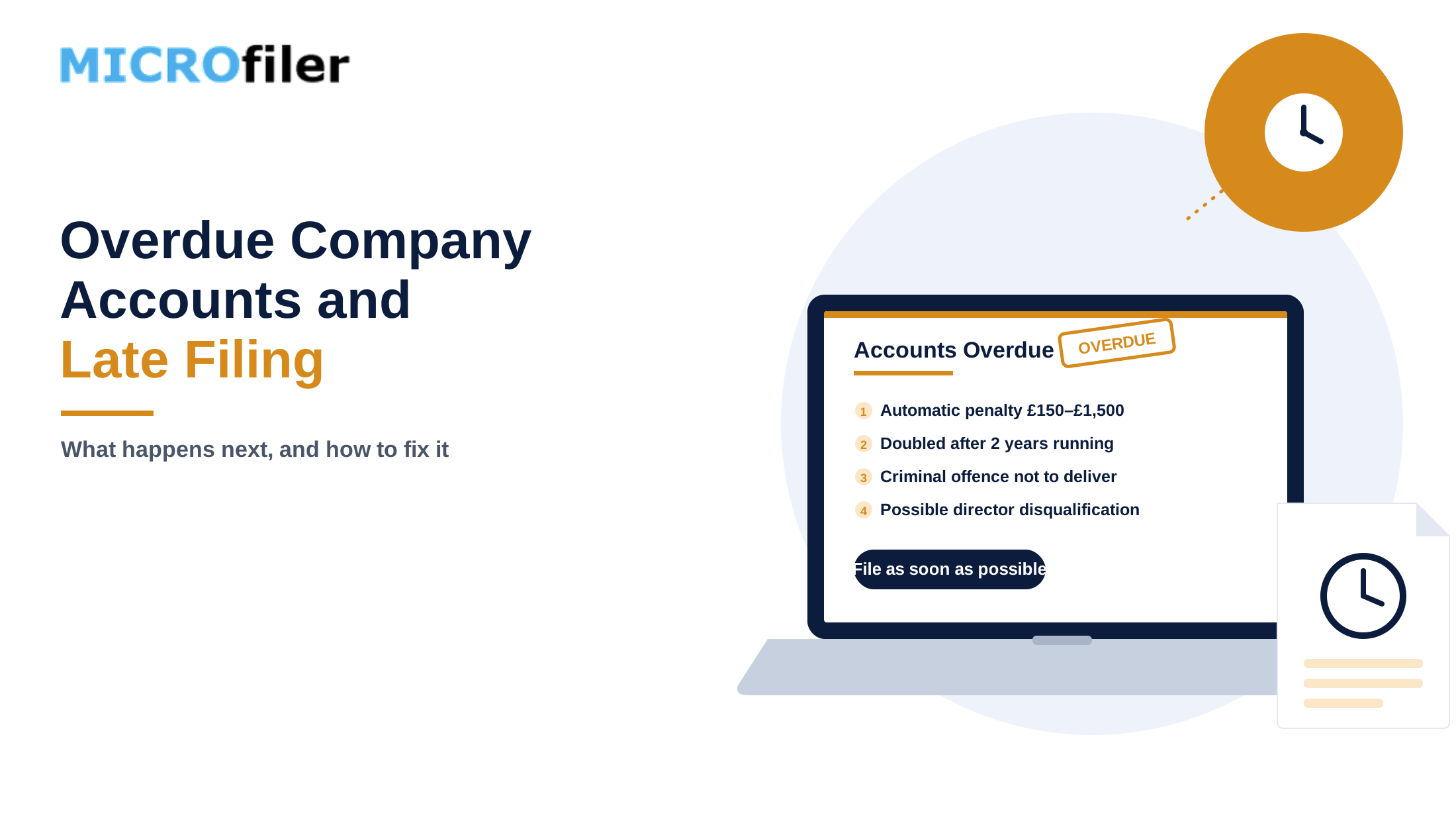
For a typical private limited company, filing annual accounts late results in an automatic penalty of between £150 and £1,500, depending on how late the accounts are. If the company files late in two successive financial years, the applicable penalty is doubled.
But the financial penalty is not the only issue. Failing to deliver accounts is also a criminal offence. Companies House can prosecute directors separately from imposing the civil late filing penalty on the company. Persistent or serious non-compliance can also lead to further enforcement action, including potential director disqualification.
The good news is that an overdue filing is a problem that can usually be addressed by getting the accounts prepared and delivered as quickly as possible.
What happens if your company accounts are overdue?
Once the filing deadline passes without acceptable accounts being delivered, the company is in default.
For subsequent accounts, a private company normally has 9 months from the end of its accounting reference period to deliver its accounts to Companies House. Public companies normally have 6 months. First accounts can have different deadlines.
Companies House then automatically imposes the applicable late filing penalty.
The director's responsibility does not disappear because an accountant normally handles the company's accounts. Directors remain responsible for ensuring the accounts are delivered before the deadline and that they are delivered in the correct format.
If your accounts are already overdue, the practical priority is:
1. Confirm exactly which accounts are outstanding.
2. Check the original filing deadlines.
3. Prepare the outstanding accounts.
4. Submit them as soon as possible.
5. Correct and resubmit anything Companies House rejects.
6. Deal with any penalty notice.
7. Respond promptly if Companies House has started enforcement or prosecution proceedings.
Do not assume that paying the penalty by itself makes the company compliant. The accounts still need to be filed.
How much is the Companies House late filing penalty?
For a private company or LLP, the current penalty bands are:
| How late are the accounts? | Private company / LLP | Public company |
|---|---|---|
| Not more than 1 month | £150 | £750 |
| More than 1 month but not more than 3 months | £375 | £1,500 |
| More than 3 months but not more than 6 months | £750 | £3,000 |
| More than 6 months | £1,500 | £7,500 |
These penalties are set out in Companies House late filing penalty guidance.
The penalty is doubled if the company files accounts late in two successive financial years.
Companies House reported 303,412 late filing penalties during 2025/26, including 73,374 double penalties for companies that had filed late in two successive years or more.
When do company accounts become overdue?
For most private companies, subsequent annual accounts are due 9 months after the end of the accounting reference period.
For example, if a company's accounting reference date is 31 December, its subsequent accounts will normally be due by 30 September of the following year.
First accounts are different. If a private company's first accounts cover more than 12 months, they normally need to be delivered within 21 months of incorporation or 3 months from the accounting reference date, whichever is longer.
This distinction matters for new companies because their first statutory accounts can cover a longer period than later annual accounts.
If you are unsure when your company's accounts are due, check the company's record with Companies House rather than relying on an old reminder or previous timetable.
Does filing late mean the director has committed a criminal offence?
There are two different consequences that are often confused.
The late filing penalty is a civil financial penalty imposed on the company. Failure to deliver accounts by the statutory deadline is a separate criminal offence.
Directors or designated LLP members can be personally fined in the criminal courts for failing to deliver accounts on time.
A late filing penalty does not automatically give a director a criminal record. A criminal record would arise from a separate criminal prosecution and conviction.
Can Companies House prosecute directors for overdue accounts?
Yes. Companies House has active enforcement powers for non-filing offences.
In August 2026, Companies House reported that between January and March 2026, 360 directors of 332 companies were convicted for filing offences, including 355 convictions for accounts offences.
A prosecution is separate from the company's civil late filing penalty.
Using an accountant does not transfer the statutory responsibility away from the director. Companies House specifically identifies relying on an accountant as a reason that is unlikely, by itself, to make a late filing penalty appeal successful.
Can a director be disqualified for late filing?
Potentially, but disqualification should not be presented as an automatic consequence of one late filing.
The general director disqualification rules allow a person to be banned from acting as a company director where they fail to meet their legal responsibilities. Not sending accounts and returns to Companies House can contribute to a disqualification case.
Companies House reported that 23 directors had been disqualified during the first six months of 2026 following persistent or serious non-compliance.
The practical distinction is important: one overdue set of accounts can result in a late filing penalty and enforcement risk, while persistent or serious non-compliance can result in much more serious consequences, including prosecution and disqualification.
Can an overdue company be struck off?
Yes, in appropriate circumstances. Companies House can take steps to strike a company off the register where it appears that the company is no longer operating or where required documents have not been filed.
Strike-off is much more serious than simply receiving a late filing penalty. Once a company is dissolved, it ceases to exist as a registered company.
If a company has already been struck off, restoration may be possible depending on the circumstances. Restoration does not simply wipe away outstanding penalties that arose before dissolution.
This is why ignoring Companies House letters or notices is rarely a sensible strategy.
What if you have several years of overdue company accounts?
Multiple years of overdue accounts require a more structured approach. Do not simply prepare the most recent accounts and assume the problem is solved.
First establish:
• Which accounting periods are outstanding.
• Which deadlines were missed.
• Whether any accounts were previously submitted and rejected.
• Which penalties have already been issued.
• Whether the company has received any enforcement correspondence.
• Whether a strike-off process has started.
• Whether Companies House has contacted any directors personally.
Then work through the outstanding filings systematically.
A sensible recovery sequence
1. Identify every missing set of accounts.
2. Reconstruct the accounting information and supporting records.
3. Prepare the accounts in filing order.
4. Submit the accounts as quickly as possible.
5. Address rejected filings immediately.
6. Deal with penalties separately.
7. Escalate if there is enforcement correspondence.
If you have received a court summons, prosecution correspondence or formal strike-off notice, the issue has moved beyond an ordinary late filing problem and may require appropriate professional advice.
Can you appeal a Companies House late filing penalty?
Yes, but the grounds are narrow. Companies House says a late filing penalty appeal will only be successful where the circumstances are exceptional.
Examples can include an unforeseen event occurring at a critical time, such as a fire destroying records shortly before the deadline.
The following reasons are specifically unlikely to succeed on their own:
• The company was dormant.
• The company could not afford the penalty.
• You relied on your accountant.
• Your accountant was ill.
• You were unfamiliar with the filing requirements.
• These were the company's first accounts.
• The directors were overseas.
• Another director was responsible for preparing the accounts.
• The accounts were delayed or lost in the post.
• The company was experiencing financial difficulties.
The current requirements are explained in GOV.UK's guidance on appealing a Companies House late filing penalty.
There is an important difference between an appeal against a civil late filing penalty and a defence to a criminal prosecution. They are separate processes and should not be treated as interchangeable.
Can you get more time to file overdue accounts?
Companies House allows companies to apply for an extension where there are exceptional circumstances, but the application needs to be made before the filing deadline has passed.
Once the deadline has already passed, an extension is not a general solution to the problem. The sensible approach is to file the overdue accounts as quickly as possible and then deal with any penalty or enforcement issue separately.
What if Companies House rejects your accounts?
Submitting something before the deadline is not necessarily enough. Companies House explains that delivery means actual receipt of accounts in the correct format.
If the filing is rejected and the corrected accounts are delivered after the deadline, the company can still receive a late filing penalty.
This is particularly important when accounts are filed on the final day. A filing made several weeks before the deadline leaves time to correct an error, while a last-minute filing may leave no practical opportunity to resolve a rejection.
What should you do if your accounts are already overdue?
If you have discovered that your company accounts are overdue, use this checklist.
1. Check the Companies House record and confirm exactly which accounts are outstanding.
2. Establish whether the company has already received a penalty notice.
3. Prepare the outstanding accounts and supporting records.
4. File as soon as possible.
5. Check whether Companies House accepts the filing and correct any rejection promptly.
6. Deal with the penalty separately by paying it where appropriate or appealing if there are genuine exceptional circumstances.
7. Check for enforcement correspondence concerning debt collection, strike-off or prosecution.
8. Get appropriate professional advice if a director has received a summons or formal prosecution correspondence.
What happens if you do not pay the late filing penalty?
An unpaid late filing penalty can be enforced. Companies House states that unpaid penalties can be passed to debt collection agencies and that the matter can ultimately be taken to the County Court or Sheriff Court.
This is not the same as saying that every unpaid penalty automatically becomes a CCJ. Court enforcement is possible, but a court judgment is not an automatic consequence simply because a penalty remains unpaid.
Companies House may also accept payment by instalments over a short period where a company has difficulty paying and contacts it to explain the circumstances.
Does paying the penalty solve overdue company accounts?
No. The penalty and the filing obligation are separate.
A company can pay a late filing penalty and still have outstanding accounts. Likewise, filing overdue accounts does not necessarily eliminate a penalty that has already been imposed.
The objective should therefore be to get the company's statutory record up to date and deal with the financial penalty or other enforcement issue.
Overdue company accounts and Corporation Tax are separate
Companies House annual accounts and the HMRC Company Tax Return are separate obligations.
A company can therefore have overdue Companies House accounts, an overdue CT600, an unpaid Corporation Tax liability, or several of these problems at the same time.
If you also need to deal with the separate tax filing, Micro Filer's CT600 Company Tax Return guide covers the return and filing process.
If your accounts are overdue, check the company's HMRC position as well rather than assuming that one filing fixes everything.
How can you avoid overdue company accounts?
The easiest overdue filing to deal with is the one that never becomes overdue.
Start before the deadline. Do not wait until the final few days to assemble bookkeeping records and prepare accounts.
Use several reminders. Set reminders well before the Companies House deadline.
Allow time for rejection. Even an apparently straightforward filing can require correction.
Check the actual deadline. The filing date is based on the company's accounting reference period, and changes to the accounting reference period can affect the deadline.
Confirm that filing has been accepted. Where an accountant or another agent submits the accounts, ask for confirmation that the accounts have actually been accepted.
Keep records throughout the year. Good bookkeeping reduces the amount of reconstruction required when annual accounts are prepared.
If your company qualifies for the simplified micro-entity regime, Micro Filer's micro-entity accounts guide explains the relevant accounts and filing requirements.
If you need help getting overdue company accounts brought up to date, Micro Filer can help eligible UK companies with their accounts and tax filing requirements.
Frequently Asked Questions
Can I still file my company accounts if they are overdue?
Yes. You should generally file overdue accounts as soon as possible. Filing late does not remove the obligation to deliver the accounts.
How much is the penalty for overdue company accounts?
For a private company, the penalty is £150 when the accounts are no more than one month late, £375 when more than one but no more than three months late, £750 when more than three but no more than six months late, and £1,500 when more than six months late.
Are late filing penalties doubled?
Yes. The applicable penalty is doubled where accounts are filed late in two successive financial years.
Does a late filing penalty give the director a criminal record?
No, not by itself. The late filing penalty is a civil penalty against the company. A criminal record would result from a separate criminal prosecution and conviction for failing to deliver accounts.
Can Companies House prosecute me if my accounts are late?
Yes. Failure to deliver accounts is a criminal offence, and Companies House actively prosecutes filing offences.
Can I be disqualified as a director for filing accounts late?
Persistent or serious non-compliance can contribute to director disqualification proceedings, but disqualification is not an automatic consequence of one late filing.
Can a dormant company have overdue accounts?
Yes. Dormant companies still have annual accounts filing obligations.
Can I appeal a late filing penalty?
Yes, but successful appeals generally require exceptional circumstances. Relying on an accountant, being unable to afford the penalty or being unfamiliar with the filing requirements is unlikely to be sufficient on its own.
What if my accountant failed to file my accounts?
The director remains responsible for ensuring the accounts are delivered on time. You should establish what happened and take steps to bring the company's filing position up to date.
Can Companies House strike off a company with overdue accounts?
Yes. Companies House can take steps to strike a company off where statutory filing obligations are not met and the circumstances justify action.
What if I have several years of overdue accounts?
Establish every outstanding accounting period, prepare the accounts systematically and file them as soon as possible. If Companies House has already started prosecution or strike-off proceedings, consider obtaining appropriate professional advice as well.