How to File Dormant Accounts with Companies House | Micro Filer Ltd
Dormant companies still have annual accounts filing obligations with Companies House. For most private companies, subsequent accounts are due 9 months after the end of the accounting reference period, and late filing can result in the same penalties that apply to other private companies.
Filing is usually straightforward when a company has never traded and has a simple financial position. However, the process can require more care if the company traded previously, still has assets or liabilities, or has had transactions that could affect its dormant status.
This guide explains how to file dormant company accounts, which companies may use Form AA02, what dormant accounts need to contain, how to check your filing deadline, and how Companies House requirements differ from Corporation Tax obligations with HMRC.
Dormant Company Accounts: Key Facts
| Question | Answer |
|---|---|
| Do dormant companies have to file accounts? | Yes |
| When are subsequent accounts due? | 9 months after the accounting reference date |
| Can dormant accounts be filed online? | Yes, where the company and accounts are eligible |
| Can every dormant company use AA02? | No |
| Does dormant status remove the confirmation statement? | No |
| Is Companies House dormancy the same as HMRC dormancy? | No |
| What are the current late filing penalties? | £150 to £1,500 for private companies |
| What changes from April 2028? | Accounts filing moves to commercial software |
Do dormant companies have to file accounts?
Yes, all limited companies generally have to file annual accounts with Companies House, even if they are dormant or have never traded. Companies House explicitly states that all companies must file annual accounts each year, including dormant companies.
Dormant status does not put the company's annual filing obligations on hold.
A dormant company will generally still need to:
- File annual accounts with Companies House
- File a confirmation statement
- Keep appropriate accounting records
- Keep company information up to date
- Deal separately with HMRC where required
A common misunderstanding is that telling HMRC a company is dormant means there is nothing else to file. Companies House and HMRC have different rules for dormancy.
A company can be dormant for Corporation Tax purposes while still being required to file annual accounts and a confirmation statement with Companies House. HMRC explains the separate tax treatment in its guidance on Corporation Tax for trading and non-trading companies.
What makes a company dormant?
For Companies House purposes, a company is dormant if it has had no significant accounting transactions during the financial year.
The key point is that "not trading" and "dormant" are not necessarily identical.
Companies House disregards certain transactions when deciding whether a company is dormant. These include:
- Money paid for shares when the company was incorporated
- Certain fees paid to Companies House
- Penalties for late filing of accounts
For example, if you incorporated a company but never started the business, the original share capital and certain Companies House fees would not, by themselves, prevent the company from being dormant. The Companies House definition of a dormant company explains which transactions are disregarded.
On the other hand, receiving customer payments, paying ordinary business expenses or receiving investment income can affect the company's dormant status.
If you are unsure whether a transaction is significant, check the position before preparing dormant accounts rather than assuming that a small transaction can be ignored.
Dormant does not necessarily mean a zero balance
A dormant company does not necessarily have a completely empty balance sheet. A company that has never traded might have a very simple balance sheet, perhaps showing its issued share capital. A company that traded in an earlier period could still have assets, liabilities, reserves or other balances after it stops trading.
This distinction is important because a company that previously traded may need more careful accounting preparation than a company that has been dormant since incorporation.
What are dormant company accounts?
Dormant company accounts are annual accounts prepared for a company that meets the Companies House conditions for dormancy.
They are generally simpler than accounts for an active trading company. For eligible dormant companies, Companies House says the accounts do not need to include a profit and loss account or directors' report.
However, simpler accounts do not mean there are no accounting responsibilities.
The directors remain responsible for ensuring that the accounts are prepared correctly, approved and filed by the deadline.
The information required can also depend on the company's circumstances. A company that has never traded may have very few figures to report, while one that traded previously may carry forward balances from earlier periods.
When are dormant company accounts due?
Dormant companies have the same filing deadlines as other companies. For a private company's subsequent annual accounts, the normal deadline is 9 months after the end of the accounting reference period. Companies House confirms the deadline.
For example, if your accounting reference date is 31 March, your subsequent accounts would normally need to reach Companies House by 31 December.
First accounts can have a different deadline. If the first accounts cover more than 12 months, a private company generally has until the longer of:
- 21 months from incorporation
- 3 months from the accounting reference date
You can check the company's specific filing deadline through its Companies House record rather than relying on a general calculation.
What happens if dormant accounts are filed late?
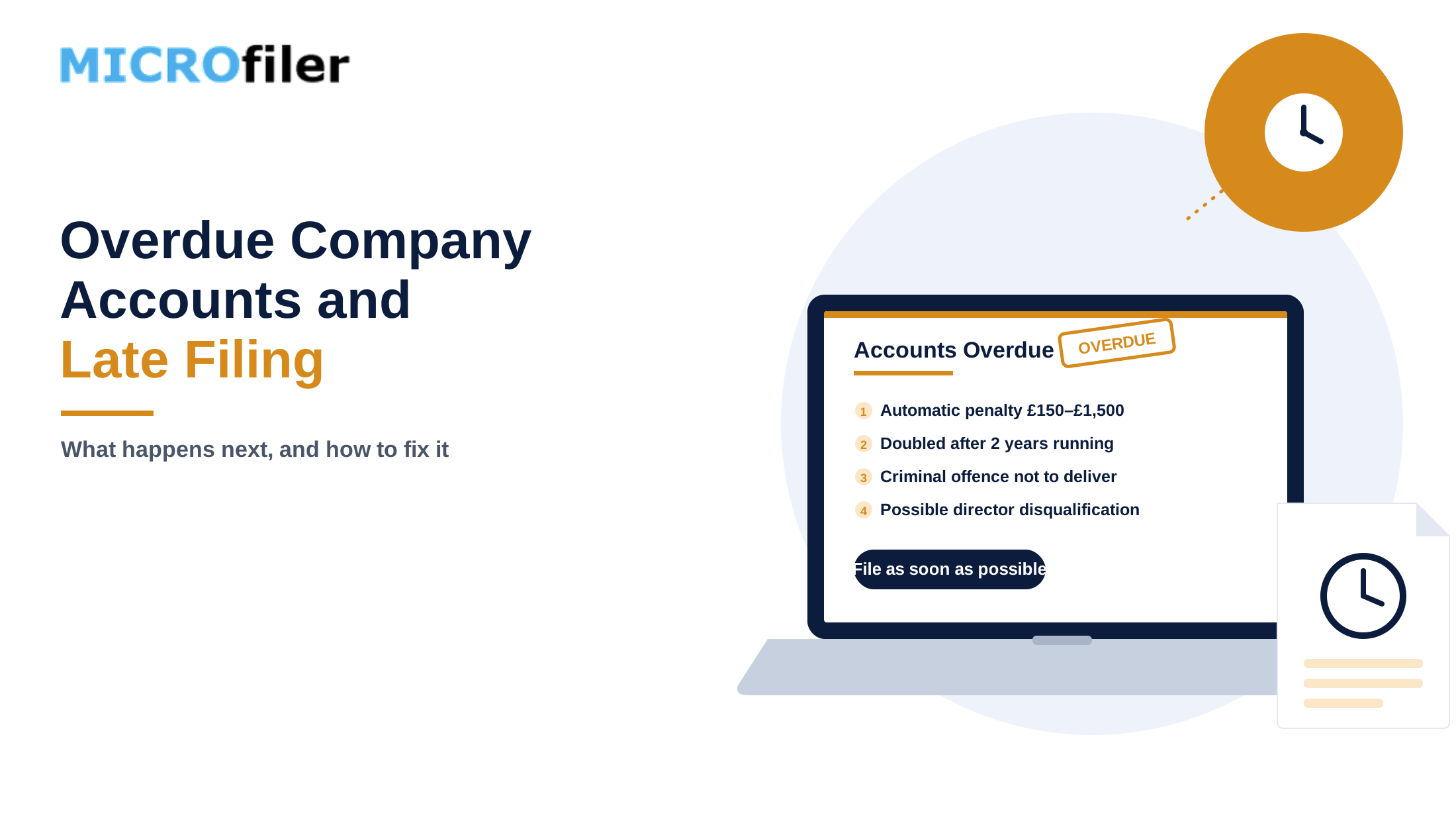
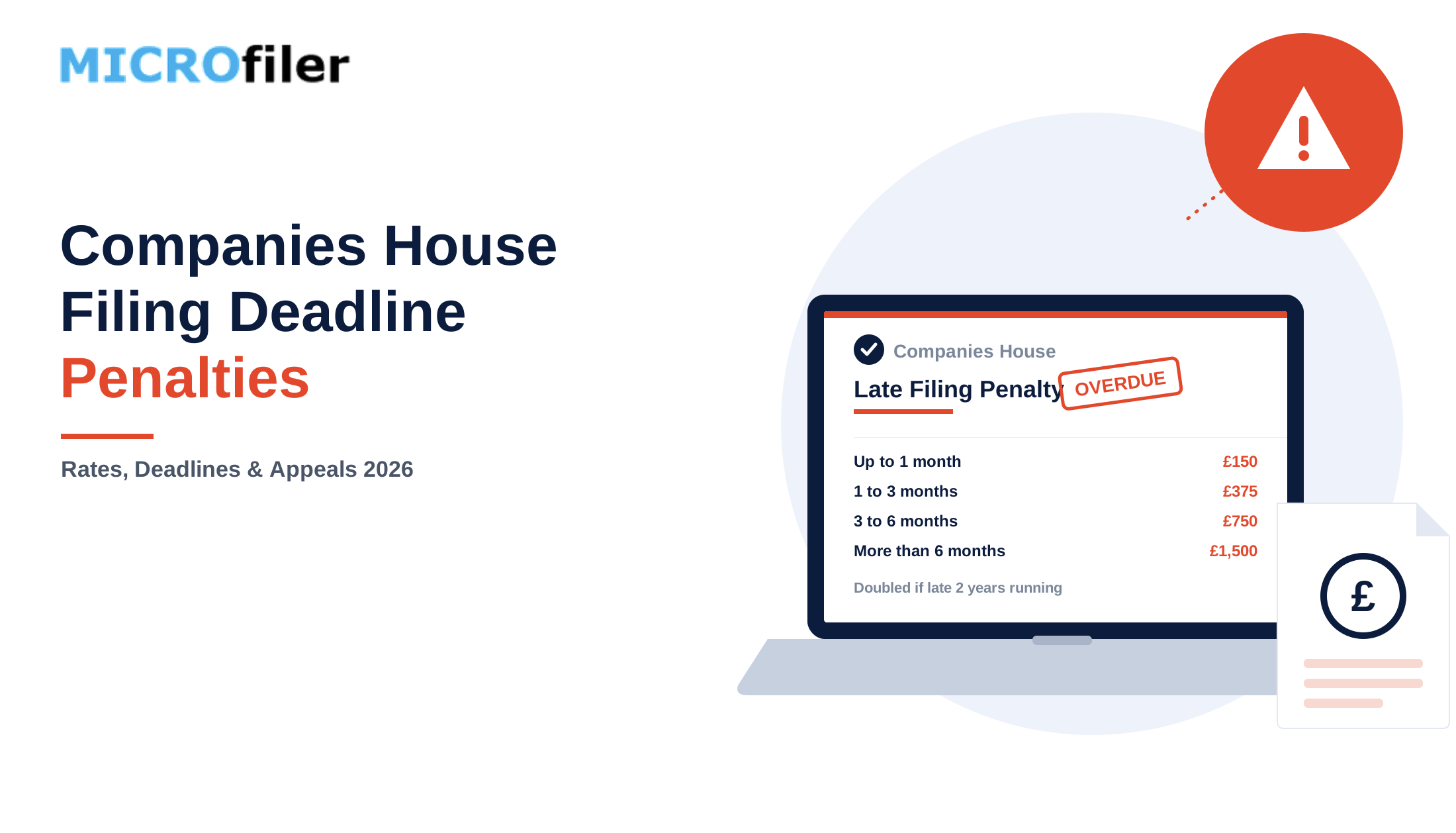
Dormant companies can receive the same late filing penalties as other private companies. The current Companies House penalty structure starts at £150 for accounts up to one month late and increases to £1,500 when accounts are more than six months late. The penalty doubles if accounts are late for two consecutive years, according to Companies House's late filing penalties guidance.
| How late are the accounts? | Private company penalty |
|---|---|
| Up to 1 month | £150 |
| More than 1 month up to 3 months | £375 |
| More than 3 months up to 6 months | £750 |
| More than 6 months | £1,500 |
So, even if your company has no income, employees or trading activity, missing the Companies House deadline can still cost the company money.
How to file dormant company accounts
The filing process depends largely on whether the company has never traded or became dormant after previously trading.
That distinction matters because not every dormant company can use the same filing route.
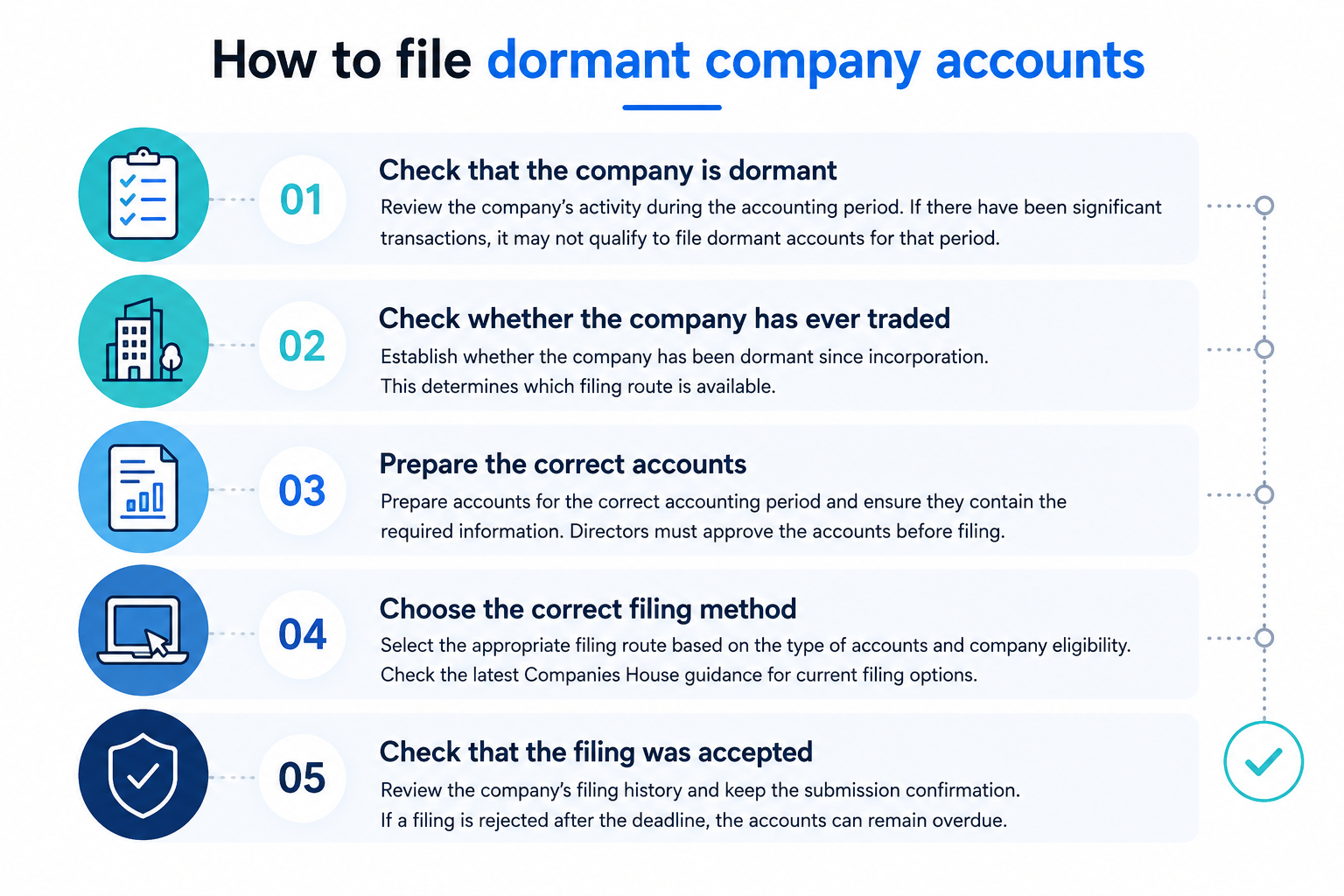
Step 1: Check that the company is dormant
Start by reviewing the company's activity during the accounting period.
Ask:
- Has the company received any income?
- Has it paid normal business expenses?
- Has it received investment income?
- Has it carried out transactions that should appear in its accounting records?
- Are the only transactions ones that Companies House specifically disregards?
If the company has had significant accounting transactions, it may not qualify to file dormant accounts for that period.
Step 2: Check whether the company has ever traded
Next, establish whether the company has been dormant since incorporation.
This is particularly important if you are considering Form AA02.
A company that has never traded may have a straightforward dormant filing route available.
A company that previously traded and then became dormant may need properly prepared dormant accounts reflecting the company's existing balances.
Step 3: Prepare the correct accounts
Prepare accounts for the correct accounting period and make sure they contain the information required for the company's circumstances.
The directors must approve the accounts before they are filed.
If the company previously traded, has assets or liabilities, or has balances carried forward from earlier years, professional accounts preparation may be worthwhile.
Step 4: Choose the correct filing method
Companies House currently provides different filing routes depending on the type of accounts being submitted.
Eligible dormant companies can use online filing options, while certain companies that have never traded can also use the dormant accounts filing route provided by Companies House.
Before using an older online guide, check when it was published. The previous joint Companies House and HMRC online service for filing accounts and Company Tax Returns closed on 31 March 2026. Current filing options are set out in Companies House's annual accounts guidance.
Step 5: Check that the filing was accepted
After submitting the accounts, check the company's filing history and keep the submission confirmation.
This matters because a rejected filing does not necessarily give you extra time. Companies House warns that if a filing is rejected after the deadline has passed, the accounts can remain overdue.
Can you file dormant accounts online?
Yes, eligible dormant companies can currently file their accounts electronically.
Companies House provides online and software-based filing options, and you can use the government's software finder for company accounts to identify software that supports the type of accounts you need to file.
If you are following an older article that refers to the joint Companies House and HMRC accounts filing service, be careful: that service closed on 31 March 2026.
What is Form AA02?
Form AA02 is a paper form for certain dormant companies; it is not suitable for every company that happens to be dormant. The simplified route is intended for companies that have been dormant and have not traded since incorporation.
A company that traded previously and later became dormant should not automatically use AA02. This distinction matters because a previously trading company may have assets, liabilities or other balances that need to be reflected in its accounts.
If you are unsure which type of accounts you have prepared, Companies House's account-type guidance can help you determine the appropriate filing route.
Do dormant companies need to file a Corporation Tax return?
Not necessarily, companies House dormancy and HMRC dormancy are separate concepts.
HMRC generally considers a company dormant for Corporation Tax purposes when it is no longer carrying out business activity. If HMRC has accepted the company as dormant, you will generally not need to file another Company Tax Return unless HMRC asks you to or the company becomes active again. HMRC's guidance on Corporation Tax for trading and non-trading companies explains the separate tax position.
However, this does not cancel the company's Companies House filing obligations. If you need to notify HMRC that the company is dormant, you can use the HMRC service for telling them your company is dormant for Corporation Tax.
Think of the obligations separately:
- Companies House: annual accounts and confirmation statement.
- HMRC: Corporation Tax obligations based on the company's tax status.
This distinction is particularly important if a company has stopped trading but still has outstanding tax or VAT obligations.
What if the company is VAT registered?
VAT creates a separate consideration. If a dormant company does not intend to trade again, it may need to deregister for VAT. If it intends to restart trading, it may need to continue submitting nil VAT returns while dormant.
If your company is VAT registered and has stopped trading, check the company's position with HMRC before assuming that dormancy removes its VAT responsibilities.
Do dormant companies still need to file a confirmation statement?
Yes, a dormant company generally still needs to file a confirmation statement with Companies House.
The confirmation statement is separate from the annual accounts.
The accounts provide financial information for the relevant accounting period, while the confirmation statement confirms that the information Companies House holds about the company is correct and up to date.
Companies House states that a confirmation statement must still be filed even when there have been no changes to the company's information.
So a dormant company can have two separate annual Companies House obligations:
- File its annual accounts.
- File its confirmation statement.
Completing one does not replace the other.
What happens when a dormant company starts trading again?
If the company starts trading again, its accounting and tax obligations change.
For Corporation Tax purposes, HMRC must be told if a dormant company starts trading again. Companies House does not require a separate notification simply because the company has restarted trading. The next set of non-dormant accounts will show that the company is no longer dormant.
If the company has been dormant for several years, reviewing its previous accounts and filing history before restarting can help identify any outstanding issues.
What is changing for dormant accounts in 2028?
The way companies file accounts is changing significantly from 2028.
From 1 April 2028, all UK registered companies will have to file their accounts using commercial software in iXBRL format. Companies House will close its current web and paper-based accounts filing routes from that date, according to its announcement about the 2028 accounts filing changes.
The reforms also change the accounts information that some companies will need to prepare and file. For example, micro-entities and small companies will face changes to profit and loss account filing from 2028.
This means that companies currently filing their own dormant accounts should not assume that today's process will remain unchanged.
If you currently use an accountant, it is worth checking that they are prepared for the move to software-only filing.
Should you file dormant accounts yourself or use an accountant?
For a company that has never traded and has a straightforward financial position, filing dormant accounts yourself may be manageable.
Professional help becomes more useful when the company's circumstances are less straightforward.
Consider using a micro company accountant if:
- The company previously traded.
- There are assets or liabilities on the balance sheet.
- The company has balances carried forward from earlier years.
- You are unsure whether a transaction affects dormant status.
- The company has received correspondence from HMRC or Companies House.
- Previous accounts may contain errors.
- You need help with both accounts and Corporation Tax.
- You simply want someone else to prepare and file the accounts.
For example, a company that has never traded and only has its original share capital may have a very simple filing requirement. A company that traded for several years before becoming dormant may have outstanding assets, liabilities or reserves that require more careful accounting treatment.
A fixed-fee dormant company accounts service can be useful if you want an accountant to prepare and file the accounts without taking on a full ongoing accounting package.
The right level of support depends on the company's history and financial position. The simplest dormant companies may not need extensive accounting work, while previously trading companies can benefit from having an accountant review the figures before filing.
Frequently Asked Questions
Can a dormant company have a bank account?
Yes, having a bank account does not automatically mean that a company is not dormant. The important question is whether the company has had significant accounting transactions. If the bank account is being used for normal business activity, however, those transactions may affect the company's dormant status.
Can a dormant company pay Companies House fees?
Yes, certain Companies House fees are disregarded when determining whether a company is dormant. These include specified filing fees paid to Companies House. This does not mean that every payment made by a company can be ignored.
Can a company be dormant after it has traded?
Yes, a company can become dormant after previously trading. However, it should not automatically use the same filing route as a company that has been dormant since incorporation. The company's previous trading activity may have left assets, liabilities or other balances that need to be reflected in its accounts.
How do I file dormant accounts with Companies House?
First confirm that the company is dormant, check whether it has ever traded, prepare the appropriate accounts and then submit them through the filing method available for those accounts. Eligible companies can currently file accounts electronically, while specific dormant companies that have never traded may have additional filing options.
How long do I have to file dormant accounts?
For subsequent accounts, a private company normally has 9 months after the end of its accounting reference period to file its accounts. First accounts can have different deadlines.
Do dormant companies pay Corporation Tax?
A company that is dormant for Corporation Tax purposes will generally not have Corporation Tax to pay for the dormant period. However, Companies House dormancy and HMRC dormancy are separate, so the company can still have annual Companies House filing obligations.
Do dormant companies need an accountant?
No, not necessarily. A straightforward company that has never traded may be able to file its own dormant accounts.
An accountant can be particularly useful where the company previously traded, has assets or liabilities, has tax questions or you simply want someone to prepare and file the accounts for you.
What happens if I do not file dormant accounts?
The company can receive a late filing penalty. For a private company, the current penalty ranges from £150 to £1,500 depending on how late the accounts are filed, and the penalty doubles if accounts are late for two consecutive years. Companies House can also take further action where required accounts or confirmation statements are not filed.
Will dormant accounts still be filed online after 2028?
The filing system will change from 1 April 2028. All companies will have to file accounts using commercial software in iXBRL format, and Companies House will close its web and paper accounts filing routes.
This article is for general informational purposes only and does not constitute professional accounting, tax, or legal advice. Tax laws, regulations, and accounting standards change frequently, and the application of rules can vary based on your organization’s specific facts and circumstances. Before acting on anything you read here, consult a qualified professional who can advise you based on your situation.