UK Small Business Tax Calendar: Key Tax and Filing Deadlines for Limited Companies
Running a UK limited company means keeping track of several different tax, accounting and Companies House deadlines. Corporation Tax, annual accounts, Self Assessment, PAYE, VAT and the confirmation statement all follow different rules.
The easiest way to stay compliant is to understand which deadlines are based on your company's accounting period, which are based on your financial year-end, and which apply to you personally as a director.
For most UK private limited companies, the key deadlines include:
- Corporation Tax payment: usually 9 months and 1 day after the end of the Corporation Tax accounting period.
- Company Tax Return (CT600): 12 months after the end of the Corporation Tax accounting period.
- Annual accounts: normally 9 months after the company's financial year-end for a private company.
- Confirmation statement: within 14 days after the end of the review period.
- Self Assessment: online tax returns are normally due by 31 January, with payments on account potentially due on 31 January and 31 July.
- PAYE: normally due to HMRC by the 22nd of the following tax month when paid electronically.
- VAT: normally due one calendar month and 7 days after the end of the VAT accounting period.
These are separate obligations. Paying Corporation Tax does not file your CT600, and filing annual accounts with Companies House does not deal with your personal Self Assessment.
UK small business tax calendar at a glance
| Obligation | Typical deadline |
|---|---|
| Corporation Tax payment | 9 months and 1 day after Corporation Tax accounting period ends |
| Company Tax Return (CT600) | 12 months after Corporation Tax accounting period ends |
| First Companies House accounts | Usually 21 months after incorporation where the first accounts cover more than 12 months |
| Subsequent Companies House accounts | 9 months after the financial year-end for a private company |
| Confirmation statement | Within 14 days after the review period ends |
| Self Assessment registration | Generally by 5 October after the relevant tax year, if required |
| Self Assessment paper return | 31 October |
| Self Assessment online return | 31 January |
| Self Assessment balancing payment | 31 January |
| Second payment on account | 31 July, where applicable |
| PAYE payment | 22nd of the following tax month when paid electronically |
| VAT return and payment | Usually 1 calendar month and 7 days after the VAT period ends |
These are general rules. Your actual deadlines can vary depending on your incorporation date, accounting reference date, Corporation Tax accounting periods, VAT scheme, payroll arrangements and personal tax circumstances.
Corporation Tax deadlines
Corporation Tax is one of the most important deadlines for a limited company, but it is also one of the easiest to misunderstand.
There are two separate Corporation Tax deadlines:
- The deadline for paying Corporation Tax.
- The deadline for filing the Company Tax Return, or CT600.
The payment deadline normally comes first.
When is Corporation Tax due?
For most companies, Corporation Tax must be paid 9 months and 1 day after the end of the Corporation Tax accounting period.
For example, if your Corporation Tax accounting period ends on 31 March 2026, the Corporation Tax payment deadline is normally 1 January 2027.
According to GOV.UK guidance on Corporation Tax and company accounts, most companies must pay Corporation Tax 9 months and 1 day after the end of their accounting period.
This means you should calculate or estimate the company's Corporation Tax liability before the payment deadline rather than waiting until the CT600 filing deadline.
When is the CT600 due?
The Company Tax Return (CT600) is normally due 12 months after the end of the Corporation Tax accounting period.
Using the same example:
- Corporation Tax accounting period ends: 31 March 2026
- Corporation Tax payment deadline: 1 January 2027
- CT600 filing deadline: 31 March 2027
HMRC explains that a Company Tax Return must normally be filed within 12 months of the end of the accounting period.
The CT600 reports the company's taxable profits, reliefs and Corporation Tax liability to HMRC.
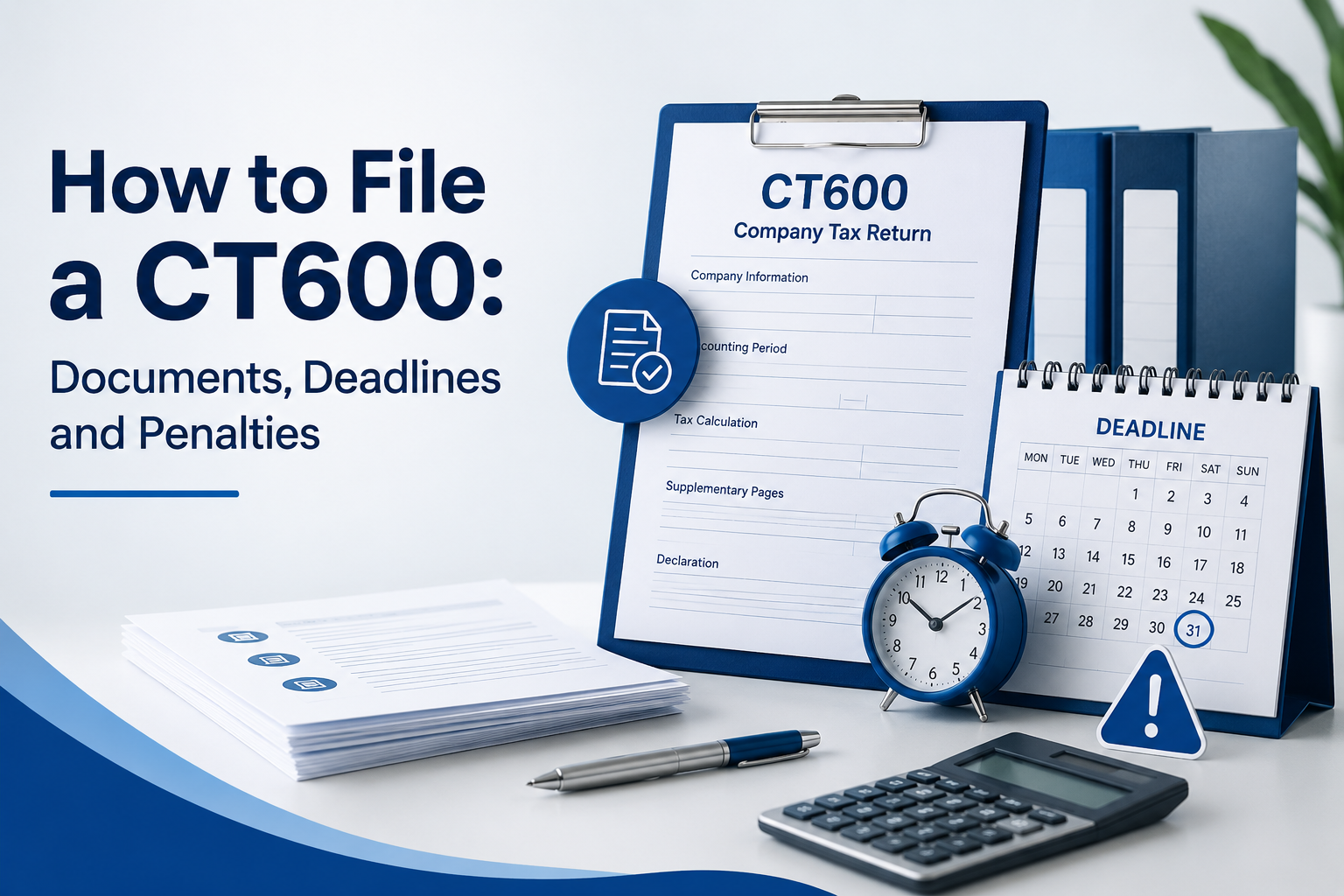
If you need help understanding the filing process, see this guide to filing a CT600 Company Tax Return.
Corporation Tax rates
For companies within the relevant Corporation Tax regime:
- Profits of £50,000 or less generally fall within the 19% small profits rate.
- Profits above £250,000 generally fall within the 25% main rate.
- Profits between £50,000 and £250,000 may be subject to Marginal Relief.
The thresholds can be reduced proportionately for short accounting periods and can also be affected by associated companies.
The current rates and Marginal Relief rules are set out in HMRC's Corporation Tax rates and allowances guidance.
What happens if a CT600 is filed late?
For Corporation Tax returns with filing dates on or after 1 April 2026, the late-filing penalty rules have changed. For a first late return, a fixed penalty of £200 applies if the return is filed late but within 3 months of the filing deadline. If the return is filed more than 3 months late, the fixed penalty increases to £400.
Higher fixed penalties can apply where a company repeatedly files late, and percentage-based penalties can apply when a return remains outstanding for longer. The updated rules are explained in HMRC's guidance on increases to Corporation Tax late-filing penalties.
This is worth checking when reading older tax guides because many still contain the previous Corporation Tax penalty amounts.
Companies House annual accounts deadlines
Annual accounts are filed with Companies House, while the CT600 is filed with HMRC.
Although the two filings use related financial information, they are separate legal obligations.
When are annual accounts due?
For a private limited company, subsequent annual accounts are normally due 9 months after the company's accounting reference date.
For many companies, this is effectively 9 months after the financial year-end.
For example:
31 December year-end → accounts normally due by 30 September the following year.
Companies House guidance on annual accounts confirms that private companies normally have 9 months from their accounting reference date to deliver subsequent accounts.
When are first company accounts due?
First accounts work differently.
If the first accounts cover more than 12 months, a private company generally has 21 months from incorporation or 3 months from the accounting reference date, whichever is longer.
For example, Companies House explains that a private company can have a first accounts deadline that is longer than the normal 9-month period because its first accounting period may extend beyond 12 months.
Do not confuse this Companies House deadline with the first Corporation Tax deadline.
A Corporation Tax accounting period cannot be longer than 12 months. Consequently, a newly incorporated company may have to file two Corporation Tax returns covering the period included in its first statutory accounts.
GOV.UK's guidance on first company accounts and Company Tax Returns explains how the first statutory accounts and Corporation Tax accounting periods interact.
Companies House late filing penalties
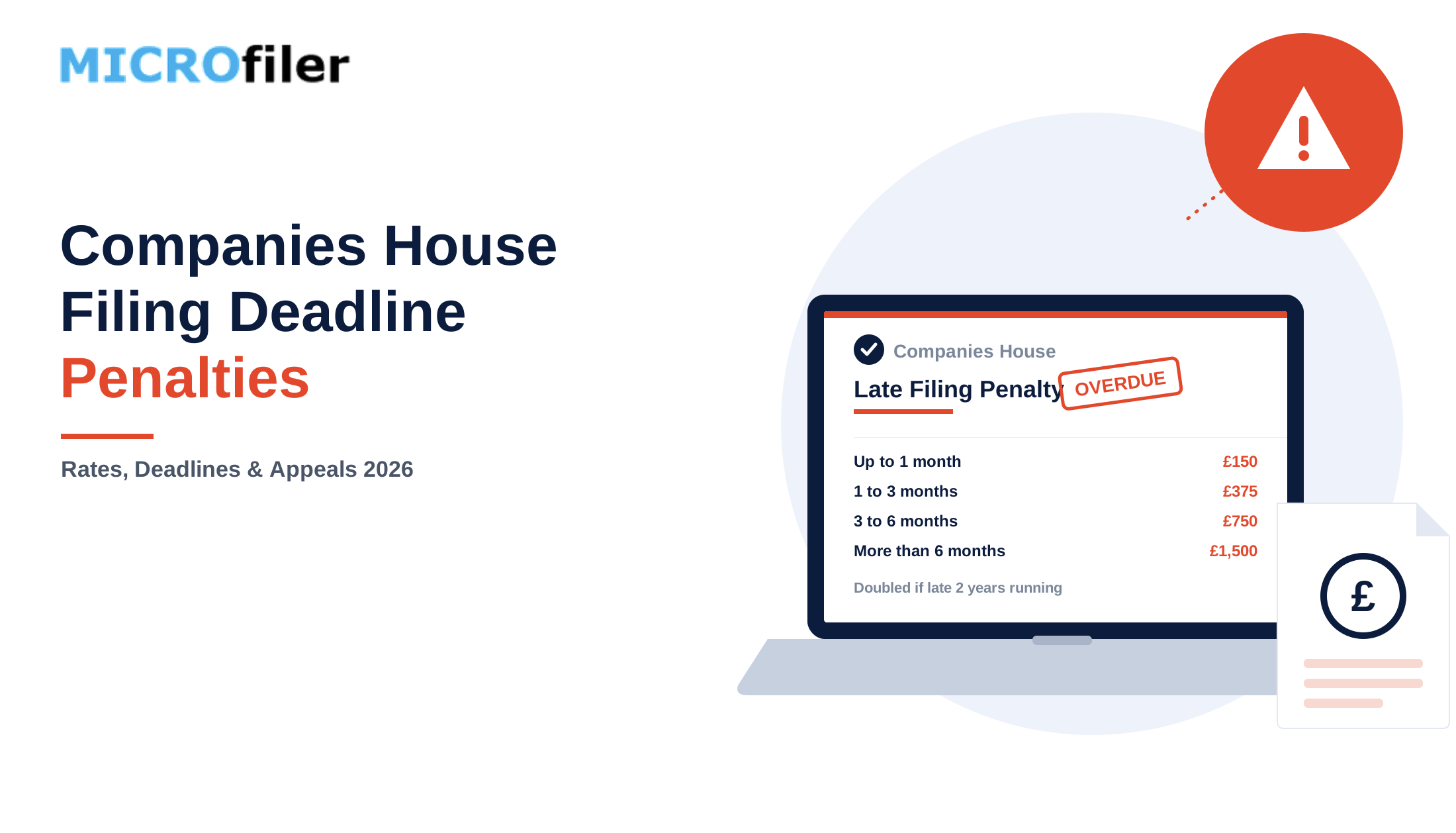
For a private limited company, late filing penalties are currently:
| How late? | Penalty |
|---|---|
| Up to 1 month | £150 |
| More than 1 month but not more than 3 months | £375 |
| More than 3 months but not more than 6 months | £750 |
| More than 6 months | £1,500 |
The penalty is doubled if accounts are filed late in two consecutive financial years. The current amounts are set out in Companies House's late filing penalty guidance.
Late accounts can also leave the company showing as overdue on the public register and, if compliance problems continue, contribute to Companies House action to strike the company off.
Do small companies need micro-entity accounts?
Some small companies qualify for the micro-entity accounts regime, which allows eligible companies to use simplified statutory accounts.
Micro-entity status does not remove Corporation Tax responsibilities. The company still needs to calculate its taxable profits and deal with its Corporation Tax liability.
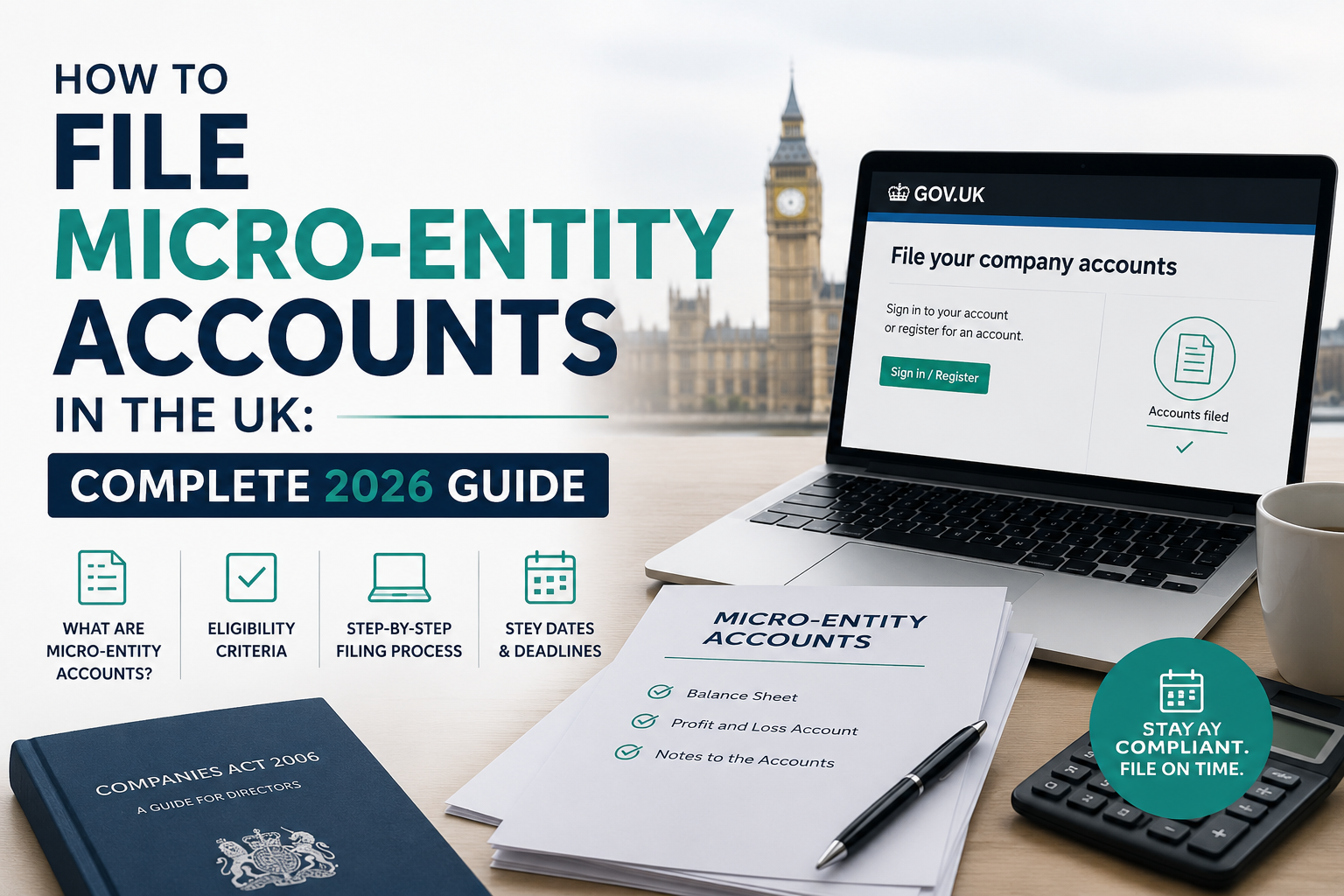
If your company may qualify, see this guide to micro-entity accounts in the UK.
Self Assessment deadlines for company directors
Your company's Corporation Tax accounting period and your personal Self Assessment tax year are not the same thing.
The UK personal tax year runs from 6 April to 5 April.
A company director may need to complete a Self Assessment tax return because of dividends, benefits, other untaxed income or other personal tax circumstances.
The company's Corporation Tax return does not deal with the director's personal tax liability.
Important Self Assessment dates
| Action | Deadline |
|---|---|
| Register for Self Assessment, if required | 5 October after the relevant tax year |
| Paper tax return | 31 October |
| Online tax return | 31 January |
| Balancing payment | 31 January |
| Second payment on account | 31 July, where applicable |
For example, the 2025/26 personal tax year ended on 5 April 2026. If you need to register for Self Assessment for that year, the normal registration deadline is 5 October 2026, while the online return and any balancing payment are normally due by 31 January 2027.
The filing dates are set out in HMRC's Self Assessment deadlines guidance.
Payments on account
Payments on account are advance payments towards a future Self Assessment liability.
Where they apply, they are normally due on:
- 31 January
- 31 July
Each payment is generally half of the previous year's relevant tax liability.
Payments on account do not apply to everyone. HMRC's rules include exceptions, including situations where the previous year's tax owed was less than £1,000 or where most of the tax was already collected outside Self Assessment.
You can read more about the rules in HMRC's guidance on Self Assessment payments on account.
PAYE and payroll deadlines
If your company employs people or pays a director through payroll, PAYE creates another recurring compliance cycle.
PAYE can involve deductions for:
- Income Tax
- National Insurance
- Student Loan repayments
- Other amounts collected through payroll
Employers also need to report payroll information to HMRC through Real Time Information (RTI).
When is PAYE due?
If you pay PAYE monthly, electronic payments normally need to reach HMRC by the 22nd of the following tax month.
If you pay by cheque, the normal deadline is the 19th.
Small employers may be able to make PAYE payments quarterly if their average monthly PAYE payment is expected to be below £1,500.
The PAYE payment schedule is therefore separate from your annual Corporation Tax and Companies House deadlines.
The current payment dates and quarterly payment rules are explained in HMRC's PAYE payment guidance.
VAT deadlines for small businesses
VAT follows another reporting cycle and is not linked to your Corporation Tax accounting period.
A business generally has to register for VAT when its taxable turnover exceeds £90,000 in a rolling 12-month period, or when it expects to exceed £90,000 in the next 30 days.
Voluntary registration is also possible below the threshold.
The current registration rules are set out in GOV.UK's VAT registration guidance.
When is a VAT return due?
For most VAT-registered businesses, VAT returns are submitted quarterly.
The standard deadline is normally one calendar month and 7 days after the end of the VAT accounting period, and the VAT payment must normally reach HMRC by the same deadline.
For example:
VAT quarter ending 30 June → VAT return and payment normally due by 7 August.
The exact filing cycle can differ depending on the VAT accounting scheme being used.
You can check the applicable deadline rules in GOV.UK's VAT return guidance.
Confirmation statement deadline
The confirmation statement is separate from your annual accounts.
Every limited company must file at least one confirmation statement every 12 months, even if none of the company's information has changed.
It is used to confirm that information held by Companies House is accurate and up to date. This can include:
- Registered office
- Directors
- Shareholders
- People with Significant Control (PSC)
- SIC codes
- Share capital
- Other information held on the company register
According to Companies House guidance on confirmation statements, the review period normally lasts 12 months and the confirmation statement can be filed up to 14 days after the review period ends.
You can also file it early.
Failure to file can result in a fine of up to £5,000, and the company may ultimately be struck off the register.
UK tax deadlines for common company year-ends
For a straightforward private limited company with a normal 12-month accounting period, the main company deadlines can be mapped from the year-end.
| Company year-end | Corporation Tax payment | CT600 filing | Companies House accounts |
|---|---|---|---|
| 31 March | 1 January | 31 March following year | 31 December |
| 30 June | 1 April | 30 June following year | 31 March |
| 30 September | 1 July | 30 September following year | 30 June |
| 31 December | 1 October | 31 December following year | 30 September |
The underlying relationships are:
Corporation Tax accounting period end → 9 months and 1 day → Corporation Tax payment
Companies House accounting reference date → 9 months → annual accounts
Corporation Tax accounting period end → 12 months → CT600
This is why the Corporation Tax payment date and Companies House accounts deadline can appear close together while the CT600 deadline arrives later.
What deadlines apply to a newly incorporated company?
A newly incorporated company can have a more complicated first year than an established company.
When the company is incorporated, Companies House assigns an accounting reference date (ARD). The first statutory accounts normally run from the incorporation date to that accounting reference date.
Because the first accounts can cover more than 12 months, the Corporation Tax position can be split into more than one accounting period.
For example, GOV.UK's guidance on first company accounts and Company Tax Returns explains that a company can have first statutory accounts covering more than 12 months, while its Corporation Tax accounting period cannot exceed 12 months. As a result, more than one Corporation Tax accounting period and CT600 may be required.
A newly incorporated company may therefore need to track:
- First Companies House accounts
- Corporation Tax accounting periods
- CT600 filing dates
- Corporation Tax payment dates
- Confirmation statement
- PAYE, if it operates payroll
- VAT, if it is VAT registered
- Personal Self Assessment, where applicable
This is why relying on the Companies House accounts deadline alone can leave a new company with missed HMRC obligations.
What happens if you miss a tax or filing deadline?
The consequences depend on which deadline you miss.
Late Corporation Tax return
A late CT600 can trigger a fixed HMRC penalty, followed by further penalties if the return remains outstanding.
For returns with filing dates on or after 1 April 2026, the fixed penalties are higher than under the previous regime. HMRC's updated Corporation Tax late-filing penalty guidance explains the current rules.
Late Companies House accounts
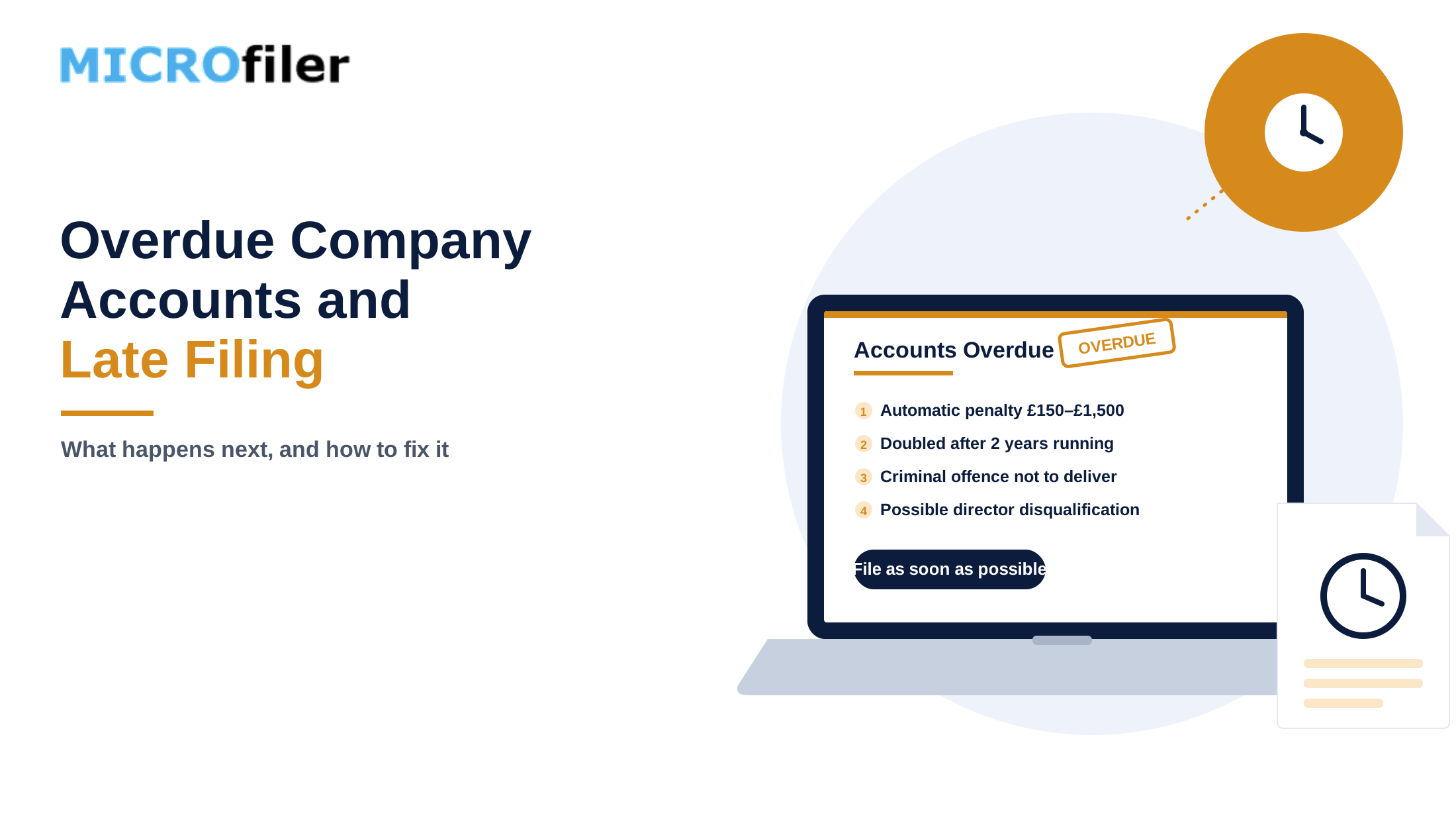
Late accounts for a private company attract penalties starting at £150 and increasing to £1,500 depending on the length of the delay. Consecutive late filing can double the penalty.
Late Self Assessment
Late personal tax returns can result in penalties, while late payment can also lead to interest and further penalties.
Late VAT
VAT has its own penalty and interest rules for late returns and payments.
Late confirmation statement
Companies House can take enforcement action where a confirmation statement is not filed. The company may be fined and can ultimately be struck off the register.
The important point is that being compliant with one obligation does not make the company compliant with all of them.
A practical annual tax calendar for a small limited company
Rather than trying to remember dozens of individual dates, create your compliance calendar around your company's year-end and recurring tax obligations.
At the start of the year
Check:
- Accounting reference date
- Corporation Tax accounting period
- Companies House accounts deadline
- Confirmation statement date
- VAT periods
- PAYE payment frequency
- Director Self Assessment requirements
Throughout the year
Keep your bookkeeping records up to date, including:
- Sales invoices
- Purchase invoices
- Bank transactions
- Business expenses
- Payroll records
- Dividend records
- Asset purchases
- VAT records
- Loan records
Good bookkeeping makes the year-end accounts and Corporation Tax calculation much easier.
Before the Corporation Tax deadline
Calculate the company's taxable profit and determine how much Corporation Tax needs to be paid.
Do not wait for the CT600 filing deadline. The Corporation Tax payment deadline normally arrives earlier.
Before the Companies House deadline
Prepare and review the annual accounts well before the deadline.
If the company qualifies for the micro-entity regime, confirm that it is using the correct reporting requirements for the relevant accounting period.
Before the CT600 deadline
Finalise the accounts and Corporation Tax computation, then submit the Company Tax Return to HMRC.
If you prefer to outsource the process, a fixed-fee company accounts and Corporation Tax filing service can handle the relevant annual accounts and tax return work without making the article itself promotional.
Before the Self Assessment deadline
If you need to submit a personal tax return, keep your personal tax position separate from the company's Corporation Tax calculation.
Consider:
- Salary
- Dividends
- Benefits in kind
- Interest
- Property income
- Other taxable income
- Payments on account
Companies House accounts changes coming in 2028
Companies House is also changing the way company accounts are filed.
From April 2028, companies will need to file accounts using commercial software in iXBRL format as part of the Companies House accounts reforms.
The reforms will also change some of the information requirements for smaller companies and micro-entities.
Companies House announced the changes in June 2026 and says businesses will have additional time to prepare. You can read the details in GOV.UK's announcement about Companies House accounts filing changes from April 2028.
If your company currently files its own accounts, it is worth considering how these software-based requirements could affect your future filing process.
Frequently Asked Questions
Is Corporation Tax due before the CT600?
Yes. For most companies, Corporation Tax is due 9 months and 1 day after the end of the Corporation Tax accounting period, while the CT600 is normally due 12 months after the accounting period ends.
Are Companies House accounts and the CT600 the same thing?
No. Companies House accounts are filed with Companies House, while the CT600 is filed with HMRC. They use related financial information but are separate filings.
When are annual accounts due for a private limited company?
For subsequent accounts, a private company normally has 9 months after its accounting reference date to deliver its accounts to Companies House. First accounts can have a longer deadline where they cover more than 12 months.
Do all company directors have to file a Self Assessment?
No. Being a director does not automatically mean that you must submit a Self Assessment return. Your personal income and circumstances determine whether you need to file.
Dividends, benefits and other untaxed income can create a Self Assessment obligation.
When is the Self Assessment deadline?
The online Self Assessment return is normally due by 31 January following the end of the relevant tax year. Where payments on account apply, they are normally due on 31 January and 31 July.
When is PAYE due?
Electronic PAYE payments normally need to reach HMRC by the 22nd of the following tax month. Qualifying small employers may be able to pay quarterly.
When is VAT due?
For most VAT-registered businesses, the VAT return and payment are normally due one calendar month and 7 days after the end of the VAT accounting period.
What happens if first accounts cover more than 12 months?
The first Companies House accounts can cover more than 12 months, but a Corporation Tax accounting period cannot exceed 12 months. This can result in more than one Corporation Tax accounting period and CT600 covering the period included in the first statutory accounts.
Can I file company accounts early?
Yes. You can file annual accounts before the deadline. Filing early gives you more time to resolve errors or rejected submissions and reduces the risk of a last-minute filing problem.
UK small business tax calendar checklist
Use this checklist to keep your company's main obligations in one place:
- Check the company's accounting reference date
- Check each Corporation Tax accounting period
- Calculate the Corporation Tax payment deadline
- Calculate the CT600 filing deadline
- Check the Companies House accounts deadline
- Check the confirmation statement date
- Check whether the director needs to file Self Assessment
- Mark 31 January and 31 July payments on account if applicable
- Check the PAYE payment schedule
- Mark VAT return dates if the company is VAT registered
- Keep bookkeeping records up to date
- Prepare annual accounts before the filing deadline
- Calculate Corporation Tax before the payment deadline
- Allow time to review and submit the CT600
- Keep an eye on Companies House filing changes coming in 2028