How to File Company Accounts in the UK
How to File Company Accounts in the UK
If you run a UK limited company, you must prepare and file annual accounts with Companies House every year. This duty applies even if the company is dormant or has never traded.
Filing company accounts is a separate obligation from filing your Company Tax Return, known as a CT600, with HMRC. Both filings draw on the same financial records, but they go to different bodies, follow different deadlines and, since 1 April 2026, use different submission routes.
This guide explains what company accounts are, which accounts your company must prepare, which accounting standard applies to them, when they are due, how to file them with Companies House, what software each filing needs, what late filing costs, and what changes from April 2028.
What Does It Mean to File Company Accounts?
Company accounts, also called statutory accounts, are financial statements prepared for a company's financial year.
They report the company's financial position and its activities over that year. Depending on the company's size and circumstances, the accounts may include:
- A balance sheet
- A profit and loss account
- Notes to the accounts
- A directors' report
- An auditor's report where required
The exact content depends on the company's size, its status and the accounting standard the directors apply.
Once the accounts are prepared and approved, the company delivers the relevant parts to Companies House. Companies House places filed information on the public register, subject to the rules governing what must be disclosed.
Company accounts are not the same filing as a Company Tax Return. The section on Companies House vs HMRC below sets out every difference between them in one place.
Who Needs to File Company Accounts?
Most UK registered limited companies must file annual accounts with Companies House. This includes:
- Trading companies
- Companies that made little or no profit
- Dormant companies
- Newly incorporated companies
- Small companies
- Micro-entities
Dormant status does not remove the filing duty. Companies House requires dormant companies to file accounts unless a specific exemption applies.
Sole traders do not file company accounts with Companies House, because a sole trader business is not an incorporated company.
Who is responsible for filing?
The company's directors carry the legal responsibility for preparing and filing accounts correctly and on time.
You can appoint an accountant or another agent to prepare and submit the accounts. Appointing an agent transfers the work, not the legal duty. The directors stay accountable for the company's statutory obligations.
What Accounts Does Your Company Need to Prepare?
Two things decide the accounts your company prepares: its size classification under the Companies Act 2006, and the accounting standard that classification allows it to use.
For accounting periods beginning on or after 6 April 2025, the micro-entity and small-company thresholds increased. Older thresholds still appear on many websites, so check which period any figures relate to.
Micro-entity accounts
A company generally qualifies as a micro-entity if it meets at least two of these three conditions:
- Annual turnover — £1 million or less
- Balance sheet total — £500,000 or less
- Average employees — 10 or fewer
Micro-entities prepare simplified accounts and may claim audit exemption where they meet the relevant conditions. A micro-entity currently files only its balance sheet with the required footnotes at Companies House, and does not have to file its profit and loss account. That position changes from April 2028.
For a fuller explanation, read our guide to micro-entity accounts. You can also follow our step-by-step guide to how to file micro-entity accounts in the UK.
Small company accounts
For accounting periods beginning on or after 6 April 2025, a company generally qualifies as small if it meets at least two of these three conditions:
- Annual turnover — £15 million or less
- Balance sheet total — £7.5 million or less
- Average employees — 50 or fewer
The same three thresholds now set the audit exemption limit for a standalone small company.
Further rules and exclusions apply, particularly to groups and to regulated businesses such as banks, insurers and other financial services firms. Meeting the headline thresholds does not automatically entitle a company to every small-company provision.
Which accounting standard applies to your accounts?
Size decides which accounts you file. The accounting standard decides how the figures inside them are recognised, measured, classified and presented.
UK companies prepare accounts under UK GAAP or, less commonly, under UK-adopted international accounting standards. The Financial Reporting Council issues the UK standards.
- FRS 105 — Who normally applies it: Micro-entities that use the micro-entities regime · What it governs: A single simplified standard with prescribed balance sheet and profit and loss formats, no revaluation of fixed assets or investment property, and no deferred tax
- FRS 102 Section 1A — Who normally applies it: Small companies, and micro-entities that opt out of FRS 105 · What it governs: Full FRS 102 recognition and measurement with a reduced set of note disclosures
- FRS 102 — Who normally applies it: Medium-sized and large companies · What it governs: Recognition, measurement, presentation and disclosure for entities outside the small-company regime
- FRS 101 — Who normally applies it: Qualifying subsidiaries inside an IFRS group · What it governs: IFRS recognition and measurement with reduced disclosures
- UK-adopted international accounting standards — Who normally applies it: Companies that choose or must apply them, such as listed groups · What it governs: Full IFRS recognition, measurement and presentation
Your accounts must state which standard was applied. The balance sheet of a micro-entity, for example, carries a statement that the accounts are prepared under the micro-entities regime.
Qualifying as a micro-entity does not force you into FRS 105. A micro-entity can prepare accounts under FRS 102 Section 1A instead, and some do, for example when the company holds investment property that FRS 105 does not allow it to revalue, or when a lender wants fuller disclosure.
FRS 102 and FRS 105 changes for periods beginning on or after 1 January 2026
The Financial Reporting Council's 2024 periodic review changed both standards for accounting periods beginning on or after 1 January 2026.
Two changes matter most for companies reporting under FRS 102:
- Revenue recognition moves to a five-step model: identify the contract, identify the performance obligations, determine the transaction price, allocate that price across the obligations, and recognise revenue as each obligation is satisfied.
- Lessees bring most leases onto the balance sheet as a right-of-use asset with a matching lease liability. Leases of low-value assets and leases with a short remaining term are exempt.
FRS 105 was not updated for the lease change. Micro-entities continue to account for leases as they did before, and FRS 105 takes only a simplified form of the revised revenue model.
These amendments change classification and presentation, so a company that grows out of the micro-entities regime into FRS 102 Section 1A can see its balance sheet change shape even when the underlying business has not.
Dormant company accounts
A company is dormant for Companies House purposes when it has had no significant accounting transactions during the financial year. Some transactions do not count as significant, such as Companies House filing fees, penalties for late filing of accounts, and money paid for shares taken by subscribers on incorporation.
A company that has been dormant since incorporation and has never traded can usually file dormant company accounts on form AA02. A company that traded in an earlier year files dormant accounts prepared under the applicable standard, normally FRS 105, consisting of a balance sheet and the required notes.
Dormancy for Companies House and dormancy for Corporation Tax are assessed separately, so a company can be dormant for one and not the other. Check both, and see our guide on how to file dormant accounts with Companies House.
When Are Company Accounts Due?
Your deadline depends on whether you are filing first accounts or later annual accounts.
First company accounts
Where a private company's first accounts cover a period longer than 12 months, they are due within 21 months of the date of incorporation, or 3 months from the accounting reference date, whichever falls later.
For example, a private company incorporated on 1 January 2025 with an accounting reference date of 31 January has a first accounting period of 13 months. Its first accounts are due by 1 October 2026, because 21 months from incorporation falls later than 3 months from the accounting reference date.
Annual accounts after the first year
For most private companies, annual accounts are due 9 months after the end of the company's financial year. A public company has 6 months.
Companies House charges an automatic penalty when accounts arrive late, so this date is worth working backwards from.
For a broader overview of important dates, see our UK small business tax calendar.
How to check your company's exact deadline
Check the company's record on the Companies House service to see the accounts due date held against the company.
Work backwards from that date and allow time for:
- Completing bookkeeping
- Resolving missing or unmatched transactions
- Preparing the accounts
- Reviewing the figures
- Obtaining director approval
- Submitting the accounts
- Correcting a rejection before the deadline
Companies House must receive acceptable accounts by the deadline, not simply receive something by the deadline.
What Do You Need Before You File Company Accounts?
Preparing the accounts comes before filing them. Depending on your company and the accounts type, you may need:
- Bookkeeping records for the financial year
- Bank statements
- Sales and purchase information
- Details of company assets
- Details of loans and finance, including lease agreements
- Payroll information
- Director transactions, including director loan account movements
- Dividend information
- The previous year's accounts and comparative figures
- Corporation Tax information
- Your company number and Companies House authentication code
- Your Government Gateway user ID and Corporation Tax UTR for the HMRC filing
- Accounts production or filing software that supports your accounts type
The exact information needed varies by company and by accounts type. The directors must approve the accounts before they are filed.
How to File Company Accounts With Companies House
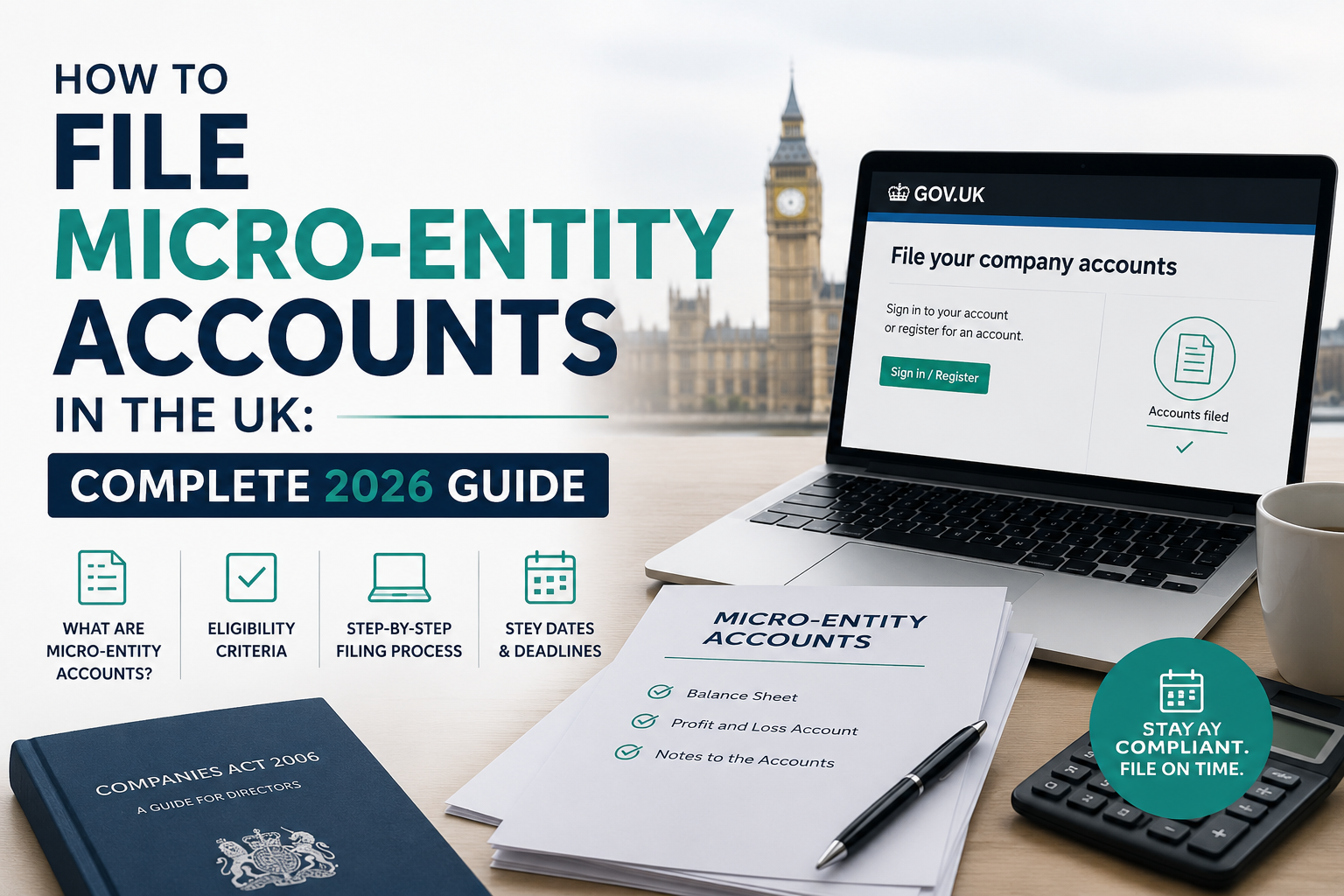
The filing process runs in six steps.
Step 1: Confirm your accounting period
Check the company's financial year and accounting reference date. This sets the period the accounts cover and fixes the filing deadline.
Step 2: Determine the correct accounts type
Establish whether the company qualifies as a micro-entity, a small company or a larger category, and whether any exclusion applies to it.
Do not pick an accounts type because it is shorter. The company must meet the legal conditions for the regime it uses.
Step 3: Prepare the accounts under the applicable standard
Prepare the accounts under FRS 105, FRS 102 Section 1A, FRS 102 or another applicable framework, as set out in the section on accounting standards above.
The standard controls how items are recognised, measured, classified and presented, and which notes the accounts carry. A simplified regime reduces disclosure, not compliance.
Step 4: Review and approve the accounts
The directors review the accounts and approve them before filing, and a director signs the balance sheet.
The balance sheet must carry the required statements, including the audit exemption statement where the company claims exemption. Companies House rejects accounts that do not meet mandatory requirements.
Step 5: Choose your filing method
Until April 2028, you can file accounts with Companies House by three routes:
- Companies House WebFiling, for unaudited small, micro-entity, dormant and certain other accounts types
- Commercial accounts production or filing software that submits in iXBRL format
- Paper accounts sent by post, which are slower and carry delivery risk
One route closed on 31 March 2026. The joint service that let a company file its accounts with Companies House and its Company Tax Return with HMRC in a single session is no longer available. Guides that still point to that combined service are out of date.
Step 6: Submit the accounts
Submit the approved accounts by your chosen route before the deadline.
If Companies House rejects the accounts, correct and resubmit them. A rejection corrected after the deadline still attracts a late filing penalty, because the original submission was not acceptable.
Companies House vs HMRC: What Is the Difference?
Treating the Companies House accounts filing and the HMRC Corporation Tax filing as one job is a common and expensive mistake. They are connected, but they are separate obligations with separate deadlines and separate submission routes.
- What you file — Companies House: Statutory accounts · HMRC: Company Tax Return (CT600), with accounts and tax computations
- Purpose — Companies House: Maintains the public company register · HMRC: Administers Corporation Tax
- Public access — Companies House: Filed accounts are generally available on the public register · HMRC: Tax information is not published
- Filing deadline — Companies House: 9 months after the financial year end for a private company · HMRC: 12 months after the end of the Corporation Tax accounting period
- Payment — Companies House: No tax is paid here · HMRC: Corporation Tax is normally due 9 months and 1 day after the accounting period ends, for companies with taxable profits up to £1.5 million
- How you file — Companies House: WebFiling, commercial software or paper until April 2028 · HMRC: Commercial software only, since 1 April 2026
Companies with taxable profits above £1.5 million pay Corporation Tax in quarterly instalments instead, and that £1.5 million limit is divided between associated companies.
Filing accounts with Companies House does not complete the Corporation Tax filing. HMRC needs its own submission.
For the tax side, see our guide to how to file a CT600 Company Tax Return.
What Software Do You Need to File Accounts and the CT600?
The two filings now follow different software rules. This is the biggest practical change for small companies in 2026.
Filing your accounts with Companies House
Companies House still accepts accounts through WebFiling and on paper. Software filing is optional today and becomes compulsory from April 2028.
Where you do file by software, the accounts must be tagged in Inline XBRL, written as iXBRL, using the taxonomy that matches your accounts type. Software built for FRS 105 micro-entity accounts will not necessarily produce a valid FRS 102 Section 1A small-company submission, so check which taxonomies your provider supports before you buy.
Filing your CT600 with HMRC
HMRC no longer offers a free online route for company accounts and tax returns. The Company Accounts and Tax Online service closed on 31 March 2026.
Since 1 April 2026, every company must use HMRC-recognised third party commercial software to file its Company Tax Return. That return has three parts:
- The CT600 form and any supplementary pages
- The statutory accounts, tagged in iXBRL
- The Corporation Tax computations, tagged in iXBRL
HMRC publishes a list of recognised Corporation Tax software suppliers on GOV.UK. A company that files its own return either picks a product from that list or appoints an agent who files on its behalf.
Choosing filing software
Check five points before you commit to a product:
- It is HMRC-recognised for Corporation Tax and produces a valid CT600
- It supports the accounting standard your company uses, whether FRS 105 or FRS 102 Section 1A
- It tags accounts and computations in iXBRL to the correct taxonomy
- It files to Companies House as well as HMRC, if you want one product for both
- It will meet the April 2028 Companies House requirements
An accountant who files on your behalf already holds compliant software, so a company that uses an agent does not have to license a product of its own for a single annual filing.
What Happens If You File Company Accounts Late?
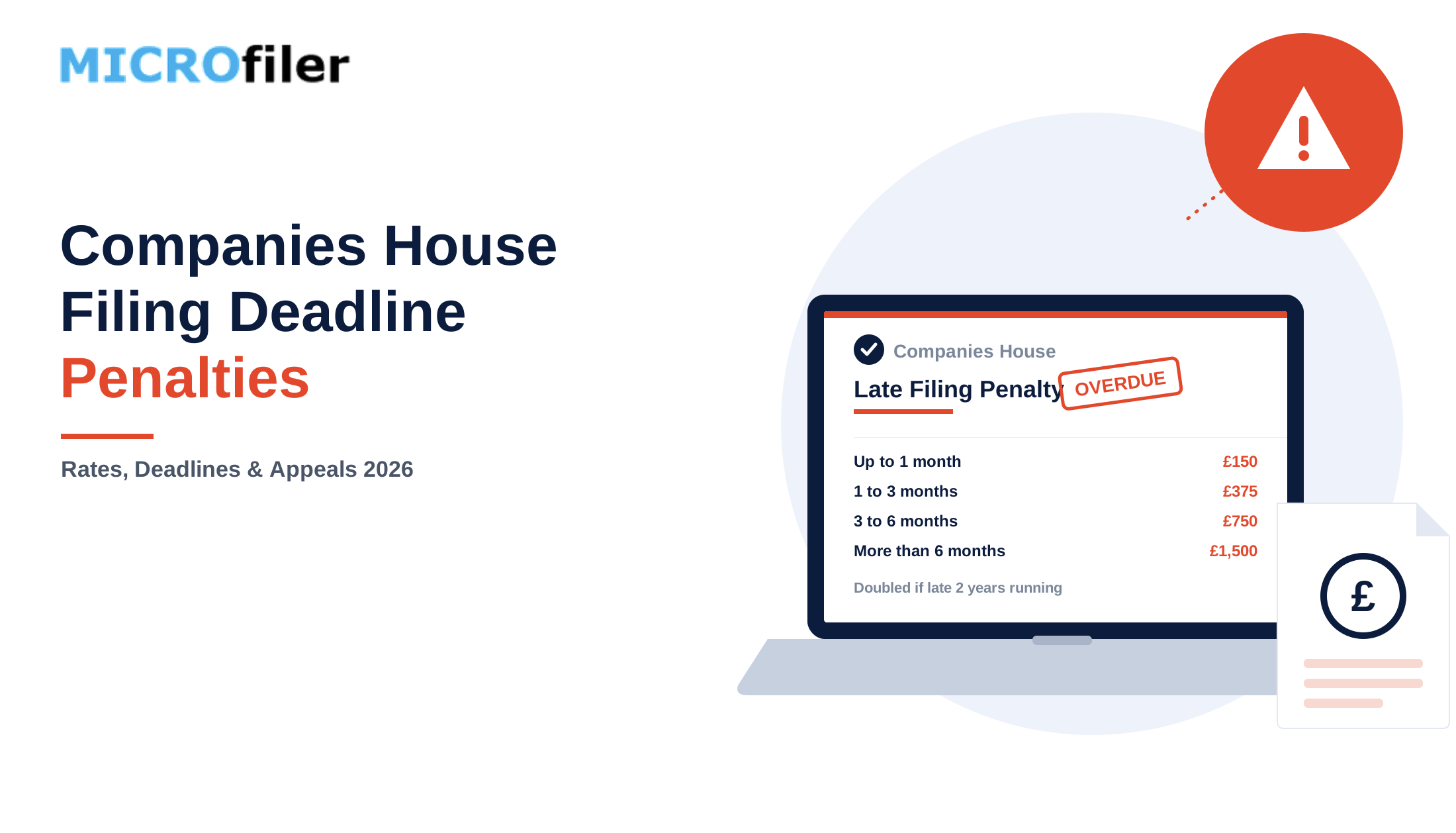
Late filing triggers an automatic financial penalty. For private companies, the penalties are:
- Not more than 1 month — £150
- More than 1 month but not more than 3 months — £375
- More than 3 months but not more than 6 months — £750
- More than 6 months — £1,500
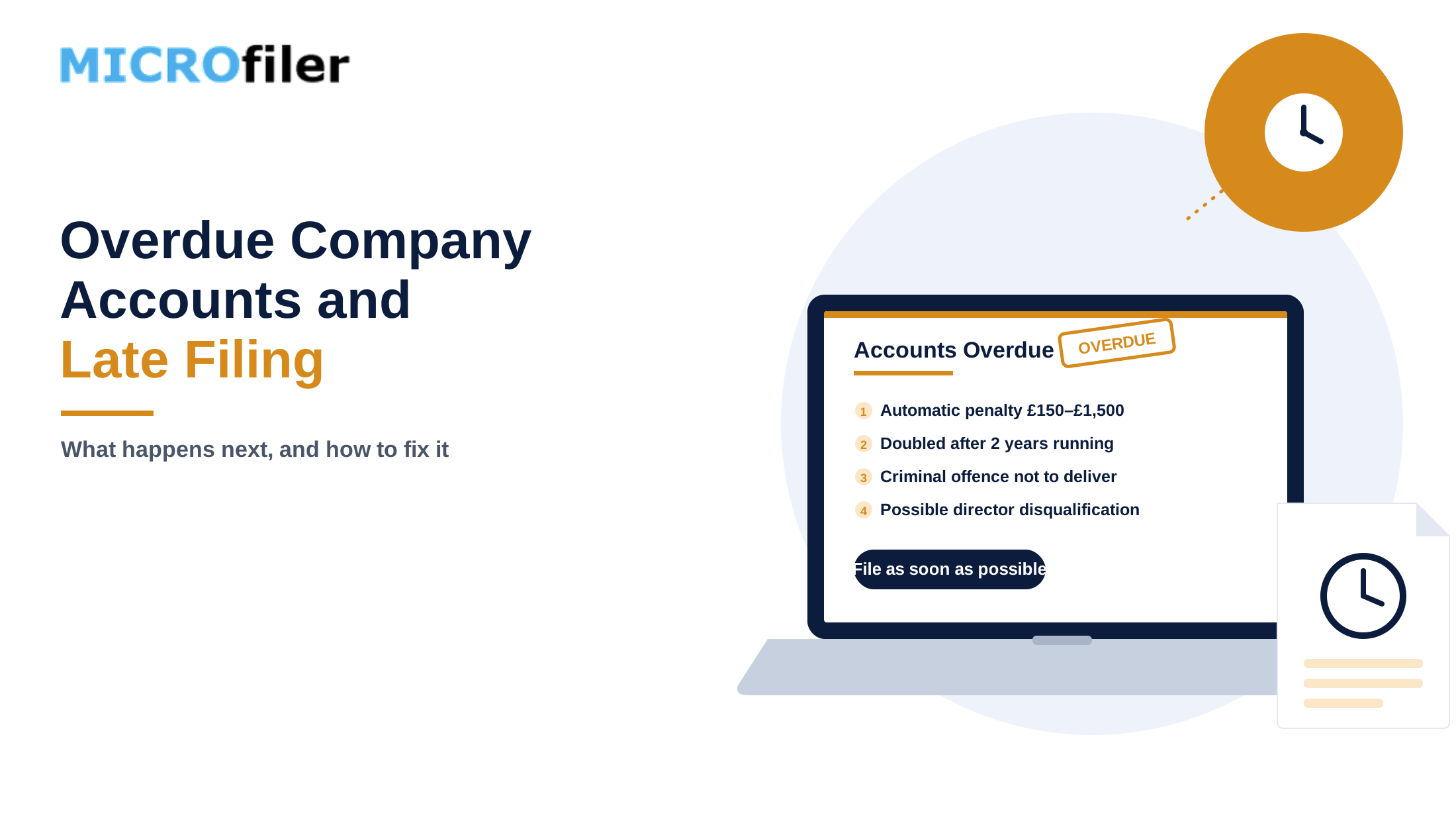
The penalty doubles where accounts are filed late in two successive financial years.
Failure to deliver acceptable accounts on time is also a criminal offence for which directors can be prosecuted personally, separate from the civil penalty charged to the company. Continued failure can lead to the company being struck off the register.
If your company has already missed its deadline, read our guide to overdue company accounts and late filing.
Can you get extra time to file?
A company can apply to extend its filing deadline where an unplanned event stops it from filing on time. The application must reach Companies House before the deadline passes.
An extension is a remedy for a specific disruption, not a routine planning tool. Prepare and submit well before the due date.
What Is Changing When You File Company Accounts From April 2028?
Companies House is changing how annual accounts are filed under the Economic Crime and Corporate Transparency Act 2023. The reforms were originally set for April 2027 and now take effect from April 2028.
The central change is that every company will file its annual accounts using commercial software in iXBRL format. Companies House will close its web-based and paper accounts filing routes on that date. The requirement applies whether a company files its own accounts or uses an agent.
Other planned changes
- Small companies and micro-entities will file a profit and loss account
- Small companies and micro-entities will be able to opt out of publishing that profit and loss account on the public register, while Companies House, HMRC and law enforcement still see it
- Abridged accounts will be withdrawn
- Companies claiming audit exemption will give an enhanced directors' eligibility statement on the balance sheet, naming the exemption claimed and confirming that the company qualifies
- The component parts of accounts and reports will be filed together rather than separately
- A company that shortens its accounting reference period more than once in five years will have to give a business reason, subject to the regulations that follow
The government moved the date to April 2028 to give companies a longer run-in, roughly one full accounting year plus the filing window that follows it.
Two questions are worth asking now. If you file your own accounts, will your software support Companies House filing under the new rules? If you use an accountant, are they ready for software-only filing?
Should You File Company Accounts Yourself or Use an Accountant?
You can prepare and file your own accounts where you understand the requirements that apply to your company, hold the records, and have a filing route that works for your accounts type.
Using an accountant tends to pay for itself when:
- You are unfamiliar with statutory accounts
- Your bookkeeping needs adjustment before the accounts can be prepared
- Your company has director loans or other complex transactions
- You are unsure which accounts regime and which accounting standard apply
- You need the Corporation Tax computation and CT600 prepared as well
- Your company is moving between size classifications
- You would otherwise buy commercial software for a single annual filing
- You want a professional review before submission
The distinction that matters is between submitting accounts and preparing compliant accounts. Companies House checks that a submission meets filing requirements. It does not tell you whether the figures inside are right, and it does not give accounting advice on your circumstances.
File your company accounts with Micro Filer
Micro Filer prepares and files company accounts for UK companies.
Micro Filer handles both filings, the statutory accounts to Companies House and the Company Tax Return to HMRC, on compliant software, so you do not have to license a product of your own.
The process runs in three stages. You provide your company records. Micro Filer prepares the accounts and the relevant tax information for your review and approval. Micro Filer then files the approved documents with Companies House and HMRC.
If you are unsure which accounts your company needs, or which accounting standard applies to them, contact Micro Filer to discuss your requirements.
Frequently Asked Questions
Do all limited companies have to file annual accounts?
Yes, with narrow exceptions. UK limited companies file annual accounts with Companies House, including dormant and non-trading companies, unless a specific exemption applies.
How long do I have to file company accounts?
A private company has 9 months from the end of its financial year, and a public company has 6 months. First accounts covering more than 12 months are due within 21 months of incorporation, or 3 months from the accounting reference date if that falls later.
Which accounting standard should my company use?
Micro-entities normally apply FRS 105, small companies apply FRS 102 Section 1A, and companies above the small thresholds apply FRS 102. A micro-entity can choose FRS 102 Section 1A instead of FRS 105, for example where it holds investment property that FRS 105 does not allow it to revalue.
Do I need software to file my company accounts?
Not yet for Companies House. WebFiling and paper filing stay available until April 2028, after which all accounts must be filed through commercial software in iXBRL format.
Do I need software to file my CT600?
Yes. HMRC's free Company Accounts and Tax Online service closed on 31 March 2026. Since 1 April 2026 every Company Tax Return is filed through HMRC-recognised commercial software, with the accounts and computations tagged in iXBRL, unless an agent files it for you.
Do dormant companies have to file accounts?
Yes. Dormant companies file accounts with Companies House, though the requirements are simpler than those for trading companies. A company dormant since incorporation that has never traded can usually file on form AA02.
What happens if my company accounts are late?
A private company receives an automatic penalty of £150 to £1,500 depending on the delay, doubled where accounts are late in two successive financial years. Late filing is also a criminal offence for which directors can be prosecuted personally.
Do I need an accountant to file company accounts?
No. Directors can prepare and file the accounts themselves. The legal responsibility sits with the directors either way, so professional help earns its cost where the accounting treatment or the filing route is unclear.
Can I file my accounts and Company Tax Return together?
Not any more. The joint service that submitted both in one session closed on 31 March 2026. The accounts now go to Companies House and the Company Tax Return goes to HMRC as two separate submissions, although a single software product can handle both.